
Kindly engage with the content of unit 3 and do all related activities.
6. Sociocultural theory
6.2. Key concepts of sociocultural theory
A. Social interaction and cognitive development:
Vygotsky believed that cognitive development is largely driven by social interactions. Learning is not an isolated process but occurs within a social context where individuals collaborate, discuss, and exchange ideas with others. Through these interactions, individuals internalize cultural knowledge and develop higher-level thinking skills. Vygotsky argued that cognitive functions (e.g., thinking, problem-solving, memory) are initially developed through social interactions with others, particularly more knowledgeable individuals such as parents, teachers, or peers. According to this theory, children learn from the guidance and support of others, which helps them internalize cultural tools and knowledge.
According to Vygotsky, learning appears twice: first on the social level and then on the individual level; i.e. between people (interpsychology) and inside the child (intrapsychology). Development cannot be separated from its social context. Vygotsky focused on a child not as an individual but as a product of social interaction, especially with adults (parents, teachers).
B. Zone of Proximal Development (ZPD):
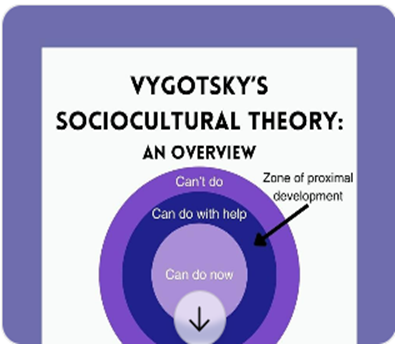
The zone of proximal development is one of the central concepts in sociocultural theory. It refers to the range of tasks that a learner can perform with the help of more knowledgeable others, such as teachers or peers, but cannot yet perform independently. The ZPD represents the difference between what a learner can do alone (independent performance) and what they can do with assistance (assisted performance). Learning occurs most effectively within the ZPD, as learners are challenged just beyond their current abilities but still within their potential capacity to achieve with help.
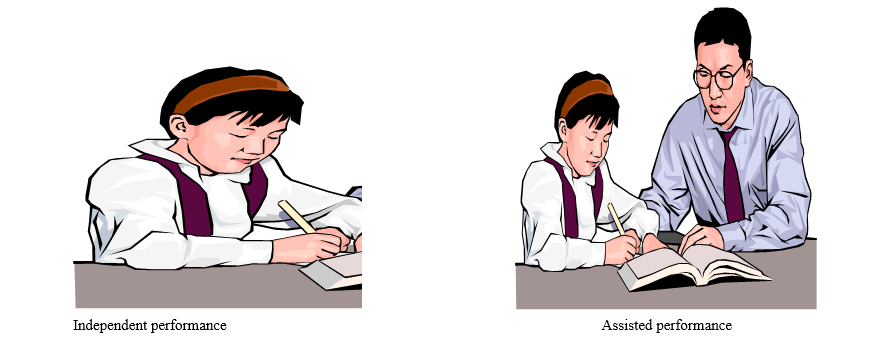
The distance between actual and potential knowledge
The concept of the distance between actual and potential knowledge is closely related to Lev Vygotsky’s concept of the Zone of Proximal Development (ZPD), which is the space between what a learner can do alone and what they can do with guidance.
- Actual knowledge refers to the information, skills, and understanding that a learner has already mastered or can do independently. It represents the learner's current cognitive abilities and what they can perform or accomplish without assistance. Example: A student who can independently add and subtract numbers or solve simple math problems has mastered basic arithmetic skills and has actual knowledge in that domain.
- Potential knowledge refers to what a learner is capable of understanding or achieving but cannot yet do independently. It represents the learner’s capacity to acquire new knowledge or skills with the assistance of a more knowledgeable person (such as a teacher or peer). Example: A student who is currently unable to solve a complex algebraic equation but has the capacity to do so with some guidance from a teacher would be seen as having potential knowledge in algebra.
The distance between actual and potential knowledge illustrates the gap between what a learner can do on their own or what a learner currently knows (actual knowledge) and what they can accomplish with guidance or what they can potentially learn with the assistance of a more knowledgeable person such as a teacher or peer (potential knowledge). That gap forms the basis for significant cognitive growth and learning. By understanding and leveraging this distance, teachers can provide effective mediation, guiding learners to new levels of understanding and ability, thus fostering growth and development.
The difference between actual knowledge (what the learner can do independently) and potential knowledge (what the learner can do with help) is the ZPD. Vygotsky emphasized that learning occurs in the ZPD, where tasks are challenging but achievable with guidance.
The process of helping learners progress from actual knowledge to potential knowledge is known as Mediated Learning. Through the interaction with a more knowledgeable person (teacher, mentor, peer), learners are given the tools, prompts, and support necessary to extend their abilities
The temporary support provided to learners to bridge the gap between their actual and potential knowledge referred to Scaffolding. The support is gradually reduced as the learner gains independence and mastery of the task.
Example of the relationship between actual and potential knowledge
Let’s consider a high school student learning calculus:
- Actual knowledge: The student knows basic algebra and trigonometry, which includes solving equations and working with functions. This knowledge is sufficient for solving simple math problems.
- Potential knowledge: The student is capable of understanding complex calculus concepts such as limits, derivatives, and integrals, but cannot do so independently yet. With targeted guidance from a teacher, the student could eventually solve calculus problems.
- Mediation in action: The teacher helps the student by explaining the concepts of calculus step by step, offering practice problems, and providing support when the student struggles with new ideas. As the student begins to grasp the concepts, the teacher reduces the level of assistance, allowing the student to work more independently.
- End result: Through mediation, the student’s actual knowledge expands to include the concepts of calculus, and the gap between their actual and potential knowledge diminishes. Eventually, the student can solve calculus problems independently, demonstrating their growth.
C. Scaffolding
It refers to the support provided by a more knowledgeable other to help a learner complete a task within their ZPD. Scaffolding is temporary and is gradually removed as the learner becomes more competent and can perform the task independently. Examples of scaffolding include teachers providing hints, asking guiding questions, or breaking down tasks into manageable steps. As the learner gains mastery, the support is faded.
D. Cultural tools
The theory highlights the importance of cultural tools (language, symbols, technology, etc.) in shaping how we think and learn. Vygotsky placed a strong emphasis on language as a key cultural tool for cognitive development i.e. for thinking and problem-solving. He believed that language is the primary means through which individuals interact with others and make sense of the world. Vygotsky argued that children learn to think and solve problems through the language and other tools provided by their culture. Through language, individuals internalize cultural norms, values, and knowledge. For example, a child learns the cultural meanings of words, rules of conversation, and problem-solving strategies through social interactions, which shape their cognitive development.
Vygotsky also highlighted the importance of private speech (talking to oneself), which children often use as a tool for self-regulation and problem-solving. As children develop, private speech becomes internalized and forms the basis for inner thought.
E. Cultural tools and Mediated Learning
According to sociocultural theory, cultural tools (e.g., language, symbols, books, computers, and other technological or social tools) mediate cognitive development. These tools help individuals process information, communicate, and engage in problem-solving. For example, mathematical symbols, written language, and calculators are all cultural tools that enable individuals to think in ways that would not be possible without them.
F. Social and cultural contexts
Sociocultural theory underscores the significance of the social and cultural environment in shaping learning. The theory posits that learning is not just an individual process but is deeply influenced by the cultural and social contexts in which a person lives. The norms, values, and practices of a particular culture impact how people think, communicate, and learn. For example, the educational practices, social interactions, and cultural expectations within a particular community or society influence the cognitive development of individuals in that community.