Resources for unit 3
| Site: | UR - Elearning Platform |
| Course: | CE80241: Theories and practices of Teaching and Learning |
| Book: | Resources for unit 3 |
| Printed by: | Guest user |
| Date: | Friday, 2 October 2026, 3:56 PM |
Description
Kindly engage with the content of unit 3 and do all related activities.
Table of contents
- 1. Behaviourism
- 1.1. Meaning of behaviourism
- 1.2. Classical conditioning or learning by association
- 1.3. Operant conditioning: Changing behavior through reinforcement and punishment
- 1.4. Meaning of operant conditioning
- 1.5. Operant conditioning: The research of Thorndike
- 1.6. Operant conditioning: Skinner’s experiment
- 1.7. Partial and continuous reinforcement
- 1.8. Application of operant conditioning in classroom settings
- 2. Cognitivism
- 3. Constructivism
- 4. Social constructivism
- 5. Social Learning Theory
- 6. Sociocultural theory
- 7. Connectivism as a Theory of Learning
1. Behaviourism
Activity: Answer the following questions:
1. What actions do you plan to take when a learner answers a question correctly?
2. What measures do you intend to take when a learner arrives late at school?
3. What decisions do you think the learner, and their classmates are likely to make in response to such situations described in 1 and 2 above?
1.1. Meaning of behaviourism
Behaviorism is a learning theory that focuses on observable behaviors rather than internal mental states. It assumes that all behaviors are learned through interactions with the environment and can be measured, changed, and controlled using reinforcement and punishment.
Behaviorism, as a learning theory, includes both classical conditioning or learning by association (Pavlov) and operant conditioning (Skinner) as types of learning that explain how behavior is acquired through interaction with the environment.
The key theorists of behaviourism include John Watson (1878–1958), Ivan Pavlov (1849–1936), Edward L. Thorndike (1874–1949) and B.F. Skinner (1904–1990).
1.2. Classical conditioning or learning by association
Classical conditioning is a learning process first described by Ivan Pavlov, a Russian physiologist. It involves learning through association, where a neutral stimulus becomes associated with a meaningful stimulus, eventually triggering a similar response: an association is made between two stimuli which are linked together to produce a new learned response. One stimulus is neutral and the other evokes a natural response. After learning the association, the neutral stimulus elicits the conditioned response.
A. Pavlov’s experiment
In his experiments, Pavlov gave the food=meat (Unconditioned Stimulus/ US) to a dog, and the dog salivated (Unconditioned Response/UR). Pavlov paired the presentation of food with the sound of a bell (Unconditioned Stimulus/ US + Neutral Stimulus/NS) and the dog salivated (Unconditioned Response/UR). After several pairings (of the sound and the food), the dogs began to salivate as soon as they heard the sound. The sound of the bell (Conditioned Stimulus/ CS) caused the dog to salivate even in the absence of food (Conditioned Response/CR). The dog had learned to associate the sound with the food that followed, or the dog had learned to salivate to a new stimulus (the sound of the bell). This is conditioning. Even without seeing the food, the dogs began to salivate at the ringing of the bell. The dog had associated the ringing of the bell with the arrival of the food and reacted accordingly (salivated).
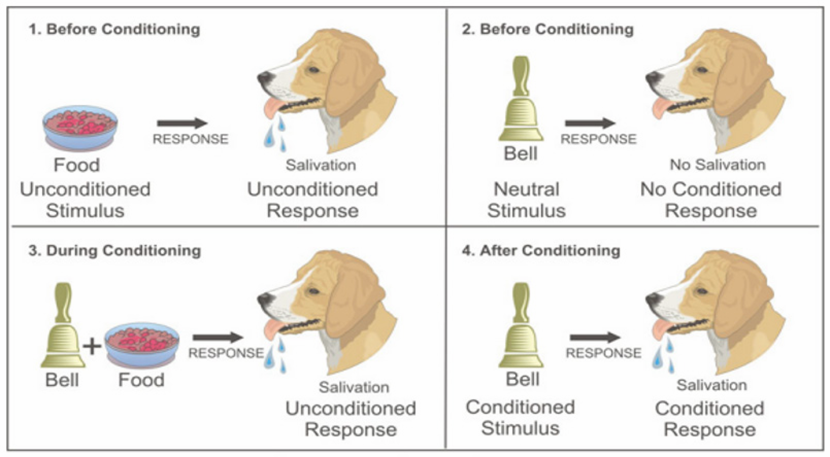
Illustration of classical conditioning (REB, 2020, p. 185)
B. Principles of classical conditioning
The principles of classical conditioning include extinction, spontaneous recovery, stimulus generalization, and stimulus discrimination.
B.1 Extinction
After the conditioning had taken place, Pavlov continued his experiment and presented the sound of the bell repeatedly but without presenting the food afterward. The behavior (salivation) rapidly decreased: the dogs salivated less and less to respond to the sound of the bell, and eventually the sound did not elicit salivation at all. The dog stopped salivating with the sound of the bell because there was no reinforcement (food). This behavior is referred to as extinction: reduction in responding that occurs when the conditioned stimulus is presented repeatedly without the unconditioned stimulus.
B.2 Spontaneous recovery
Pavlov found that, after a pause, ringing again the bell elicited salvation, although to a lesser extent than before extinction took place. The increase in responding to the CS following a pause after extinction is known as spontaneous recovery, that is, the reminiscence of earlier learning. Although at the end of the first extinction period the CS was no longer producing salivation, the effects of conditioning had not entirely disappeared.
B.3 Stimulus generalization
Pavlov also experimented with presenting new stimuli that were similar, but not identical to, the original conditioned stimulus. He found that dogs also salivated upon experiencing similar stimulus, a process known as stimulus generalization: the tendency to respond to stimuli that resembles the original conditioned stimulus.
The ability to generalize has important significance: If we eat some red berries and they make us sick, it would be a good idea to think twice before we eat some purple berries. Although the berries are not exactly the same, yet they are similar and may have the same negative properties.
B.4 Stimulus discrimination
The opposite of generalization is stimulus discrimination: the tendency to respond differently to stimuli that are similar but not identical. Pavlov’s dogs quickly learned, for example, to salivate when they heard the specific tone that had preceded food, but not upon hearing similar tones that had never been associated with food.
Discrimination is also useful: if we do try purple berries, and if they do not make us sick, we will be able to make the distinction in the future. And we can learn that although the two people in our class, Moses and Peter, may look alike, they are, however, different people with different personalities.
C. Application of classical conditioning in classroom settings
The teachers can apply classical conditioning in the classroom by doing the following:
- Avoid presenting painful experiences (stimuli) to learners as they may learn (become conditioned) to fear or hate school. For example, a teacher who frequently humiliates a learner for giving a wrong answer may cause that learner to fear participation or even dislike attending school. Instead, correcting mistakes in a supportive and respectful manner helps maintain a positive learning environment.
- Identify the most important aspects of the lesson and emphasize them so that learners can discriminate or differentiate them. For instance, during a science lesson, a teacher may highlight and repeatedly stress the formula and key terms, while using diagrams or bold writing on the board to help learners focus on what matters most.
- Give learners more opportunities to use and repeat the knowledge they have acquired. For example, after teaching a new mathematical concept, a teacher can provide multiple practice exercises, group work activities, or short quizzes, allowing learners to apply the concept several times in different contexts until it becomes familiar.
- Reinforce desired behaviors and punish undesired ones. For instance, praise students after they answer questions correctly. Over time, students may begin to associate the teacher’s specific praise with positive reinforcement, making them feel more engaged and eager to participate. This helps create an atmosphere where students are conditioned to feel positive emotions toward classroom activities.
- Encourage desirable behaviors by associating those behaviors with positive stimuli: For example, a teacher can offer verbal praise (UCS) when a student raises their hand before speaking (NS). Over time, the student will begin to associate raising their hand (CS) with praise (CR), leading to more frequent hand-raising during class discussions.
- Reduce negative behaviors through extinction: If a student feels anxious when called on to speak in class (due to negative past experiences), the teacher can work to reduce this fear by consistently praising or encouraging the student when they participate, eventually removing the negative association with speaking in front of the class.
- Help students develop positive emotional responses toward learning activities: Examples, a teacher who consistently provides positive feedback when a student participates in discussions can condition the student to feel a sense of pride and confidence when engaging in those activities. A student who initially feels nervous about presenting in front of the class might begin to associate the act of speaking in front of others with praise and recognition from the teacher. Over time, the student may experience positive emotions toward public speaking, due to the conditioned emotional response.
- Using music to enhance focus: Teachers can use background music or specific sounds as neutral stimuli (NS) and pair them with productive learning experiences, turning the sound or music into a conditioned stimulus (CS). Over time, students may become conditioned to focus or feel more relaxed when they hear the music or sound. For instance, a teacher may play soft classical music while students are doing independent work. Over time, the students will associate the music with concentration and productivity, leading them to feel more focused whenever they hear it.
1.3. Operant conditioning: Changing behavior through reinforcement and punishment
Activity: Have you ever been rewarded for good behavior or performance in class? What was the implication in terms of your behavior and learning?
1.4. Meaning of operant conditioning
 Operant conditioning, sometimes referred to as instrumental conditioning, is a type of learning first developed by Edward L. Thorndike and later expanded by B.F. Skinner. Operant conditioning emphasizes how behavior is shaped and maintained by its consequences. It is learning that occurs based on the consequences of behavior and can involve the learning of new actions. In operant conditioning, the organism learns from the consequences of its own actions. Unlike classical conditioning (which is based on association), operant conditioning involves voluntary behaviors and how they are influenced by rewards or punishments.
1.5. Operant conditioning: The research of Thorndike
An American Psychologist Edward L. Thorndike (1874–1949) was the first scientist to systematically study operant conditioning. In his research, Thorndike (1898) observed cat who had been placed in a “puzzle box” from which they tried to escape. After many attempts, the cat accidentally pressed the lever that opened the door and went to their prize: a small piece of fish.
The next time, the cat was constrained within the box, it attempted fewer of the ineffective responses before carrying out the successful escape, and after several trials the cat learned to almost immediately make the correct response.
The research of Thorndike: The law of effect
Observing these changes in the cats’ behavior led Thorndike to develop his law of effect, the principle that responses that create a typically pleasant outcome in a particular situation are more likely to occur again in a similar situation, whereas responses that produce a typically unpleasant outcome are less likely to occur again in the situation. The key idea of the law of effect is that successful responses, because they are pleasurable, are “stamped in” by experience and thus occur more frequently. Unsuccessful responses, which produce unpleasant experiences, are “stamped out” and subsequently occur less frequently.
1.6. Operant conditioning: Skinner’s experiment
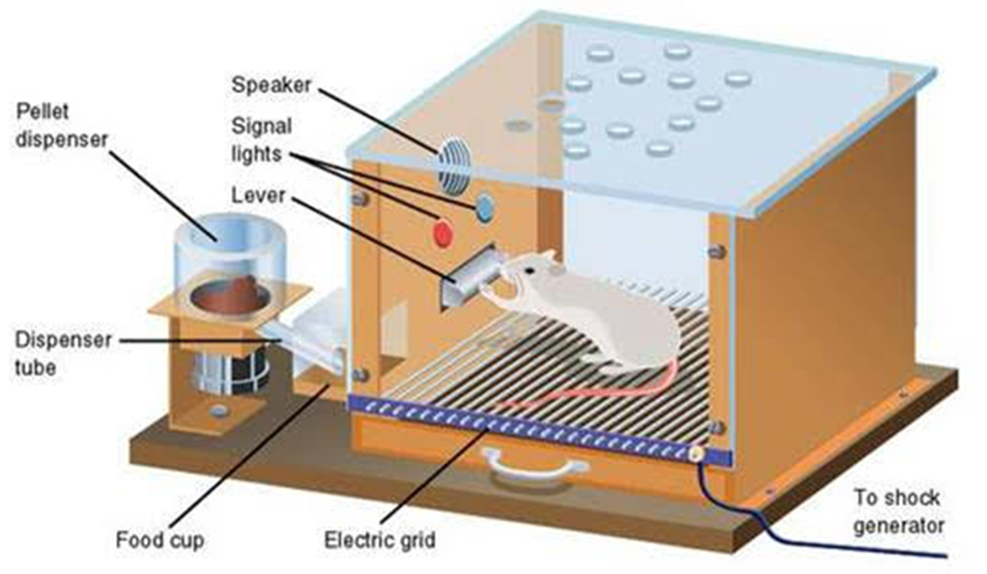
The most famous behaviorist was Burrhus Frederick (B. F.) Skinner (1904–1990). B. F. Skinner expanded on the Thorndike’s ideas to develop a more complete set of principles to explain operant conditioning. His experiments were quite similar to the Thorndike’s research with cats. He used a Skinner box to study operant learning. The box contains a bar or key that the organism can press to receive food and water, and a device that records the organism’s responses.
Skinner placed a hungry rat in a box (Skinner box). The box had a lever or button the animal could press, a dispenser for food (as a reward) and sometimes, an electrified floor to deliver mild punishment. The installation of the box ensures that when the bar is pressed, the food will be released into the cup. The rat started to explore after smelling the food and accidentally pressed the bar, causing food to fall into the cup and the rat ate the food. The next time, the rat took a little less time to press the lever, and on successive trials, the time it took to press the lever became shorter. Soon, the rat pressed the lever as fast as to eat the food that appeared (the reinforcer of the response). The rat had learned to repeat the action that brought about the food and cease the actions that did not.
A. Key concepts in skinner’s operant conditioning
Skinner studied, in detail, how animals changed their behavior through reinforcement and punishment, and he developed terms that explained the processes of operant learning:
- Reinforcer refers to any event that strengthens or increases the likelihood of a behavior.
- Punisher refers to any event that weakens or decreases the likelihood of a behavior.
- Positive and negative reinforcement or punishment to refer to whether a reinforcement or punishment was added/presented or removed, respectively.
- Reinforcement: a consequence that increases the likelihood of a response/ behaviour to occur. Reinforcement, either positive or negative, works by increasing the likelihood of behavior
- Positive reinforcement: adding a good/pleasant stimulus after a response in order to encourage the response to continue. Examples: A teacher might praise a student for completing their work on time or for showing kindness to a classmate. Compliments like Great job! I’m really impressed by your effort, or You’re really focusing well today! Encourage the student to repeat the behavior. At the end of the week or month, students who have shown consistent effort, good behavior, or academic improvement might receive awards: “Student of the Month” awards, or other forms of recognition.
- Negative reinforcement: removal of an undesirable stimulus after a response so that the response will occur more often. Examples: If a student consistently turns in assignments on time, the teacher might reduce the amount of homework assigned to that student, thereby reinforcing the behavior of punctuality and responsibility. If a student is in a timeout for misbehaving but then demonstrates improved behavior, the teacher may choose to end the timeout earlier than expected, thus reinforcing the positive behavior.
- Punishment: a consequence that decreases the likelihood of a response/behaviour to occur. It refers to any event that weakens or reduces the likelihood of a behavior. If you are using punishment, you are trying to decrease the behaviour.
- Positive punishment: Adding a negative consequence after undesired behavior is exhibited, the behavior is less likely to happen in the future, will occur less or stop. Examples: Giving extra work to a student for misbehaving; a child who is beaten after fighting with a sibling is less likely to repeat these behaviors. A student receives a call phone in classroom, and he/she picks up the call and starts talking in class, the teacher then reprimands him in front of the whole class and adds his homework to be twice as much as the rest of the students. The consequence or the punishment of receiving a phone call discourages him from repeating the action again. Positive punishment weakens a response by presenting something unpleasant after the response. It involves adding something unpleasant to discourage behavior.
- Negative punishment. Removing a certain desired or pleasing stimulus after a particular undesired behavior is exhibited, resulting in the behavior happening less often in the future, will occur less or stop Taking away television or video games from a child for misbehaving so that he or she will stop misbehaving. A child who loses the opportunity to go to recess after getting a poor grade) is less likely to repeat these behaviors. A student who really enjoys a specific class, such as gym or music classes at school, negative punishment can happen if he/she is removed from that class and sent to the principal’s office because he/she is misbehaving. Taking the cell phone of a student after receiving a call in class. If a student misbehaves, the teacher might take away a portion of their recess, which is something they enjoy. Negative punishment weakens a response by reducing or removing something pleasant. It involves removing something desirable to decrease behavior.
Although the distinction between reinforcement (which increases behavior) and punishment (which decreases it) is usually clear, in some cases, it is difficult to determine whether a reinforcer is positive or negative. For example, on a hot day, a cool breeze (gentle wind) could be seen as a positive reinforcer (because it brings in cool air) or a negative reinforcer (because it removes hot air). In other cases, reinforcement can be both positive and negative. One may smoke a cigarette both because it brings pleasure (positive reinforcement) and because it eliminates the craving (strong desire) for nicotine (negative reinforcement).
1.7. Partial and continuous reinforcement
One way to expand the use of operant learning is to modify the schedule on which the reinforcement is applied. There are two main types of reinforcement schedules: continuous reinforcement and partial reinforcement.
- In continuous reinforcement, the desired behavior is reinforced every time it occurs. For instance, whenever the child gets good marks, he/she gets a biscuit. A student receives praise every time they turn in their homework on time. Continuous reinforcement results in relatively fast learning but also rapid extinction of the desired behavior once the reinforcer disappears. The problem is that because the organism is used to receiving reinforcement after every behavior, the responder may give up quickly when it doesn’t appear.
- In partial reinforcement, the desired behavior is reinforced only some of the time, not every time it occurs. Partial reinforcement occurs at irregular intervals: the responses are sometimes reinforced, and sometimes not. A student may receive praise for their behavior occasionally, but not every single time they act appropriately. A student might be given a reward (like extra recess time or a privilege) on an unpredictable schedule, making it less predictable when they will earn it. This encourages the behavior to continue because the student is unsure when the next reward will come.
The four types of partial reinforcement schedules
Partial reinforcement schedules are determined by whether the reinforcement is presented on the basis of the time that elapses between reinforcements (interval) or on the basis of the number of responses that the organism engages in (ratio). These are:
• Fixed-ratio schedule
• Variable-ratio schedule
• Fixed-interval schedule
• Variable-interval schedule
In a fixed-ratio schedule, a behavior is reinforced after a specific number of responses or reinforcement is provided after a set number of responses or behaviors. For instance,
• A student gets a small prize of a pen for example after completing 5 math problems correctly.
• A student receives a notebook after every 10 books they read or after every 10 assignments they complete.
This type of reinforcement leads to a high rate of response, as students know exactly what they need to do to get the reward. However, once the student earns the reward, they might take a short break before resuming work, as the reinforcement is predictable.
A variable-ratio schedule provides reinforcers after a specific but average number of responses or Reinforcement is provided after an unpredictable number of responses or behaviors. The number of responses needed to get reinforced varies around average. A teacher randomly praises a student after an unpredictable number of correct answers or positive behaviors. For instance, they might praise a student after 3, 5, or 8 correct answers in class, but the praise is not given on a set schedule.
This type of reinforcement tends to create a high, stable rate of responding because students never know when the reinforcement will come, keeping them motivated to engage continuously. Ratio schedules tend to produce high rates of response because reinforcement increases as the number of responses increases.
In a fixed-interval schedule, reinforcement occurs for the first response made after a specific amount of time has passed or reinforcement is provided after a fixed amount of time has passed, regardless of the number of responses or behaviors. Examples:
• Weekly quiz: Every Friday, the teacher gives a quiz on the material studied during the week. Students are reinforced (either through a grade or verbal praise) for their performance on the quiz, regardless of how many answers they get correct.
• Time-based rewards: After a specific time interval (e.g., every 30 minutes), the teacher gives a short break to students who have been working steadily during that period.
Students may exhibit bursts of activity as the time for reinforcement approaches, but there may be a decrease in activity right after the reinforcement. For example, there might be a burst of study efforts just before the quiz. Most students study for exams in the same way.
In a variable-interval schedule: the reinforcers appear on an interval schedule, but the timing is varied around the average interval, making the actual appearance of the reinforcer unpredictable or Reinforcement is provided after a variable amount of time has passed, with the time interval varying around an average. A teacher might give short quizzes throughout the week, but the students don't know when these quizzes will happen. Since the reinforcement (in this case, grades or praise after each quiz) comes at random intervals, students tend to stay prepared and engaged. Quizzes are given at unpredictable intervals, so students don't know when to expect one. The timing of the quizzes varies. A teacher might randomly check whether students are on task during independent work. The student doesn't know when the teacher will come around, so they remain focused and keep working in case the teacher checks in. A teacher might provide praise or a small reward at random times throughout the lesson. For example, a student who consistently contributes to class discussions might receive praise, but the teacher does not follow a set schedule for when to provide it.
Interval reinforcement schedules tend to produce slow and steady rates of responding. This schedule encourages consistent and steady behavior, as students know they will eventually receive reinforcement, but they are unsure of exactly when it will occur. This can lead to higher levels of sustained engagement, as students remain attentive and active in anticipation of reinforcement.
1.8. Application of operant conditioning in classroom settings
The teachers can apply operant conditioning in the classroom by:
- Deciding what behavior they want from learners (clear instructional objectives) and reinforce that behavior when it occurs. Each correct response of a learner should be reinforced.
- Providing feedback on progress and linking rewards with that progress.
- Using positive reinforcement: Teachers can use rewards like praise, stickers, or tokens to reinforce desired behaviors, such as participation, completing tasks, or staying on task.
- Using negative reinforcement: The removal of an undesirable stimulus, such as reducing homework for consistently good behavior, can encourage students to behave positively.
- In classroom management, teachers can establish clear rules and routines, providing consistent consequences for actions (e.g., a time-out for disruptive behavior).
- Using repetition and drills: Through frequent practice (e.g., activities, tests), students learn through repetition and reinforcement of learned behaviors.
But the use of positive reinforcement in changing behavior is almost always more effective than using punishment. This is because positive reinforcement makes the person or animal feel better, helping create a positive relationship with the person providing the reinforcement.
Although reinforcement can be effective in education, and teachers make use of it by awarding good grades, and praise, there are also substantial limitations to using reward to improve learning. To be most effective, rewards must be contingent on appropriate behavior.
In some cases, teachers may distribute rewards indiscriminately, for instance by giving praise or good grades to children whose work does not warrant it, in the hope that they will “feel good about themselves” and that this self-esteem (confidence in abilities) will lead to better performance. Studies indicate, however, that high self-esteem alone does not improve academic performance.
When rewards are not earned, they become meaningless and no longer provide motivation for improvement. Another potential limitation of rewards is that they may teach students that the activity should be performed for the reward, rather than for one’s own interest in the task. If rewards are offered too often, the task itself becomes less appealing. Some children may engage in an activity for a reward, rather than because they simply enjoyed it.
Punishment is generally less effective than reinforcement in changing behavior. For instance, students who are punished for bad behavior are likely to change their behavior only to avoid the punishment, rather than internalizing the norms of being good for its own sake. Punishment also tends to generate anger, defiance, and a desire for revenge. Punishment is more likely to create only temporary changes in behavior because it is based on coercion and typically creates a negative and adversarial (conflict or opposition) relationship with the person providing the punishment. When the person who provides the punishment leaves the situation, the unwanted behavior is likely to return.
2. Cognitivism
Activity:
- When you are trying to learn something new, like a math formula or a new language, what happens in your mind?
- Think about the last time you had to remember something for a test or exam. What did you do to help yourself remember it?
2.1. Description of cognitivism
Cognitivism is a learning theory that focuses on the internal mental processes involved in learning, such as thinking, memory, perception, attention, judgement, problem-solving and metacognition. It focuses on how people think, understand, and know about the world. It put emphasis on learning how people understand and represent the outside world within themselves and how our ways of thinking about the world influence our behavior. It emerged in response to the limitations of behaviorism, which focused only on observable behavior and ignored the mental activities of the learner (Giannoukos, G. (2024).
Cognitivism was influenced by technology like other sciences. Beginning in the 1960s, growing numbers of psychologists began to think about the brain and human behavior in terms of the computer, which was being developed and becoming publicly available at that time. Cognitivism focuses on mental processes which correspond well to the processes that computers perform. Cognitivists compare human thinking to the workings of a computer, which takes in information and transforms, stores, and retrieves it. In their view, thinking is information processing. Cognitivism view learners as active participants who process, store, and retrieve information. The theory suggests that learning occurs when learners make sense of and organize new information by connecting it with their existing knowledge. According to cognitivists, mental processes and past knowledge influence behavior or response more than external stimuli do (Schunk, 2021; Ormod, 2020).
Some of the important contributors to cognitivism include:
- The German psychologist Hermann Ebbinghaus (1850–1909), who studied the ability of people to remember lists of words under different conditions;
- The English psychologist Sir Frederic Bartlett (1886–1969), who studied the cognitive and social processes of remembering;
- Jean Piaget, George Miller, and Eleanor Rosch work to understand how people learn, remember, and make judgments about the world around them. For instance, the idea that our memory is influenced by what we already know was also a major idea behind the cognitive- developmental stage model of the Swiss psychologist Jean Piaget (1896–1980) and
- Lev Vygotsky (1896–1934), a Russian psychologist who worked on cognitive development.
2.2. Application of cognitivism in classroom settings
- Giving activities that encourage deep thinking, such as problem-solving tasks, discussions, and concept mapping.
- Activating prior knowledge: Teachers begin lessons by asking questions or using brainstorming to connect new content to what students already know.
- Teachers can use strategies like scaffolding to support learners as they progress through tasks, gradually reducing help as they become more proficient. Example: In teaching math problem- solving, the teacher may first demonstrate how to solve a problem, then guide the student step- by-step, and eventually encourage the student to solve problems independently.
- Use of visual aids and concept maps: Encourage students to create visual representations of the relationships between concepts, which helps organize and deepen understanding. Concept maps help learners organize their thoughts, integrate new information with prior knowledge, and visualize complex ideas, making abstract concepts more concrete. Example: After learning a unit on ecosystems, students could create a concept map that connects key concepts such as food chains, biodiversity, and the water cycle.
- Fostering active learning: Encourage students to engage in activities that require them to process information, that promote critical thinking and problem- solving rather than passive reception of information such as group discussions, problem-solving tasks, and hands-on experiments. Example: Students work on group projects or participate in debates where they are required to apply theoretical knowledge to real-world scenarios.
- Promoting metacognition: helping students become aware of how they learn, their learning strategies and reflect on their understanding of the learning materials. For example: Before a test, the teacher might ask students to review their study strategies and think about which methods helped them understand the material best.
- Use Problem-Based Learning (PBL): encourage students to work in groups to solve complex, real-world problems.
- Use cognitive apprenticeship: students learn through observation, practice, and collaboration with an expert. Learning is best achieved in authentic contexts where learners can observe and participate in real tasks. For example: In a science classroom, the teacher models how to conduct an experiment, explaining the steps and reasoning behind the process. Students then replicate the experiment, initially with guidance and eventually independently. This helps students develop both problem-solving skills and a deeper understanding of how knowledge is applied in real-life contexts.
- Paced repetition: A teacher can use this technique where information is reviewed at increasing intervals over time, aiding in long-term retention and the reinforcement of cognitive schemas. Spaced repetition helps solidify information in long-term memory and encourage deeper cognitive processing, improving retention and recall.
- Inquiry-Based Learning: involves students actively participating in their learning by posing questions, investigating answers, and engaging in exploration. This stimulates curiosity, encourages active exploration, and fosters higher order thinking skills such as analysis, synthesis, and evaluation.
Activity:
1. Choose a topic in one of the subjects you teach or will teach in secondary schools and explain how you will apply cognitive learning theory to teach that topic.
2. Discuss the benefits and challenges of applying cognitivism in classroom contexts.
3. Constructivism
Activity: How do you know that the sun rises in the East?
3.1. Description of constructivism
Constructivism is a learning theory emphasizing that learners construct their own understanding and knowledge of the world, through experiencing things and reflecting on those experiences. It is rooted in the idea that learning is an active, contextual, and social process, rather than a passive absorption of information. It emphasizes the active role of learners in constructing their own understanding of the world.
According to this theory, knowledge is actively built by learners as they interact with their environment. Learning is seen as an active process where students build on prior knowledge. Learning is seen as a process of discovery and personal meaning-making. It is learner-centered, focusing on the idea that learners create their own meanings through experiences, problem-solving, and reflection.
This theory is rooted in the work of Jean Piaget, Jerome Bruner, David Ausubel, and other psychologists, who emphasized that learning occurs best when students engage in active exploration and critical thinking, building on prior knowledge and experiences.
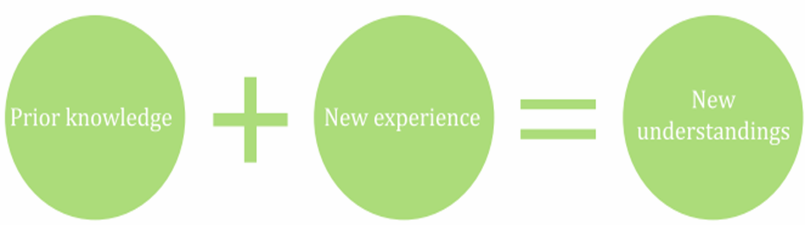 Illustration of constructivism (REB, 2020)
3.2. Core principles of constructivism
The core principles of constructivism emphasize that learners actively construct knowledge through experience, interaction, and reflection, making learning a meaningful and personalized process.
- Knowledge is constructed, not transmitted: Learners actively build new knowledge by connecting it to their prior experiences and understanding.
- Learning is an active process: It involves exploration, questioning, problem-solving, and engagement with the environment.
- Social interaction supports learning: Learning often occurs through dialogue, collaboration, and interaction with others, teachers, peers, or even community members.
- Contextual and situated learning: Learning is most meaningful when it is embedded in real-life or authentic contexts, not isolated facts or drills.
- Learner-centered approach: The teacher acts as a facilitator or guide, not a transmitter of knowledge. Students are empowered to take ownership of their learning.
- Scaffolding: Teachers provide temporary support to help learners complete tasks that they cannot do independently but can accomplish with guidance. As learners gain mastery, the support is gradually reduced.
- Learning is a social activity where sharing and negotiating knowledge is the norm, and students will work in small groups.
- Prior knowledge: Learners build new knowledge upon their existing knowledge and experiences. This prior knowledge serves as the foundation for further learning.
- Problem-solving: Constructivism values real-world problem-solving and critical thinking. It encourages learners to engage in tasks that require them to make decisions, solve problems, and reflect on their learning.
- Self-directed learning: Students are encouraged to take responsibility for their own learning, promoting autonomy and self-regulation.
3.3. Key theorists of constructivism
- Jean Piaget (1896–1980): Piaget is one of the most well-known theorists in constructivism. His work focused on how children develop cognitive structures and how these structures evolve through stages as they actively interact with their environment. Key contributions:
§ Cognitive development stages: Piaget proposed four stages of cognitive development: sensorimotor, preoperational, concrete operational, and formal operational.
§ Assimilation and accommodation: He emphasized the processes of assimilation (fitting new experiences into existing cognitive structures) and accommodation (changing cognitive structures to fit new experiences).
§ Piaget believed that children actively construct their understanding of the world by interacting with it.
2. Jerome Bruner (1915–2016):
Bruner argued that learning is an active process where learners construct new ideas based on their current and past knowledge. Key contributions:
§ Discovery learning: Bruner advocated for teaching methods that encourage learners to discover information themselves, as opposed to passively receiving knowledge.
§ Spiral curriculum: He proposed that curriculum should revisit key concepts regularly at increasing levels of complexity.
§ Scaffolding: Bruner emphasized the importance of providing learners with support structures that enable them to achieve tasks they can't accomplish alone.
3. David Ausubel (1918–2008): While not always associated with the term "constructivism," Ausubel's theory of meaningful learning fits within a broader constructivist framework. Key contributions:
§ Meaningful learning: Ausubel distinguished between meaningful learning (where learners relate new information to their existing knowledge) and rote memorization.
§ He proposed that new knowledge should be presented in a way that connects to the learner's existing cognitive structures to make it meaningful and easier to retain.
3.4. Classroom applications of constructivism
Teachers create environments where students are encouraged to explore, ask questions, and solve real-world problems, with the teacher acting as a facilitator rather than a direct instructor. The following are examples of applications of constructivism learning theories in teaching and learning.
- Inquiry-based learning: Teachers must encourage students to ask questions, explore, and discover answers independently or through collaboration. For instance, in a literature class, rather than merely summarizing a book, students might be asked to inquire into the themes, character motivations, or author’s intent. They could discuss their hypotheses with peers, research their questions, and present their findings.
- Collaborative learning: Students can learn from each other, share ideas, and engage in joint problem-solving. The role of the teachers is to create opportunities for collaborative learning through group work, peer discussions, and collaborative problem-solving tasks. These help students build knowledge through social interaction. For example, in a history class, students can work in groups to research different aspects of a historical event and then present their findings to the class. This fosters deeper understanding as they learn from each other and work together to create a comprehensive picture of the topic.
- Project-Based Learning (PBL): an effective way to allow students to explore real-world problems and build knowledge through hands-on experiences. In PBL, students work on a project over an extended period of time, developing solutions, conducting research, and collaborating with peers. For example, in a science class, students might work on a project to design and build a sustainable model of a city. They would use principles of physics, engineering, and environmental science to solve problems and create prototypes, integrating knowledge from various subject areas.
- Use of real-world problems: Teachers can design tasks that simulate real-life challenges and require students to engage in critical thinking and problem-solving. Like in a geography class, students might be asked to design a community garden for their school, considering factors like climate, soil quality, and community needs. This requires them to apply geographic and environmental knowledge in a practical, problem-solving context.
- Make real-world connections: connect lessons to real-life situations to make learning meaningful and relevant. for example, applying math skills to budgeting or discussing current events in the context of history.
- Scaffolding: Teachers provide guidance, resources, and support tailored to the learner’s current level of understanding. This support can be gradually reduced as students become more capable of working independently. Example, in a math class, a teacher might start by providing step-by-step instructions for solving a complex problem. Over time, the teacher might provide fewer cues, allowing the students to solve similar problems on their own as their confidence and competence grow.
- Differentiated instruction: constructivist teachers recognize that students have varying levels of prior knowledge, skills, and learning preferences. They differentiate instruction by providing multiple avenues for students to engage with content, ensuring that all learners are appropriately challenged. For example, in a classroom where students have different reading levels, the teacher might offer a range of texts on the same topic: some may be more visual, others may be more complex, allowing each student to engage with the material at their own level.
- Learner-centered environment: Constructivist classrooms are student-centered, with a focus on creating an environment that encourages exploration, curiosity, and self-directed learning. Teachers act as facilitators rather than lecturers, guiding and supporting students as they engage with the content. Example: In a literature class, students may have the freedom to choose a book that interests them and then share their insights or analyze the themes with their classmates. This approach allows students to take ownership of their learning and develop intrinsic motivation.
- Reflective thinking/reflection: encouraging students to reflect on their learning (through journals or discussions) is an important aspect of constructivism. Normally, reflection helps learners make sense of new information, identify gaps in understanding, and consolidate their knowledge. Example here is, after completing a research project, students could be asked to reflect on what they learned, the challenges they encountered, and how they overcame them. This reflection helps them internalize their learning and apply it to future tasks.
3.5. What teachers do in constructivist classrooms
In constructivist classrooms, teachers:
- Seek and value their learners’ points of view;
- Pose problems and structure classroom experiences that foster the creation of personal meaning;
- Don’t provide everything, they incite learners to build knowledge;
- Assess continually learning
- Continually adjust the level of facilitation in response to the learners’ level of performance (Scaffolding).
Activity: Mr. Muneza, a geography teacher, presents a real-life problem with farmers facing soil erosion. He takes learners outside to observe the school environment and nearby land for signs of erosion, such as gullies or rills. In groups, students identify causes and suggest solutions. Returning to class, they use resources like atlases and tablets to compare their findings with global practices. Each group then prepares and presents a report. Throughout the process, Muneza promotes critical thinking by asking guiding questions and encouraging discussion.
Question: To what extent did the teacher apply constructivism?
4. Social constructivism
Constructivism and social constructivism are both theories of learning that emphasize the active role of the learner in constructing their understanding of the world. Social constructivism builds on the ideas of constructivism but emphasizes the social aspects of learning
4.1. Description of social constructivism
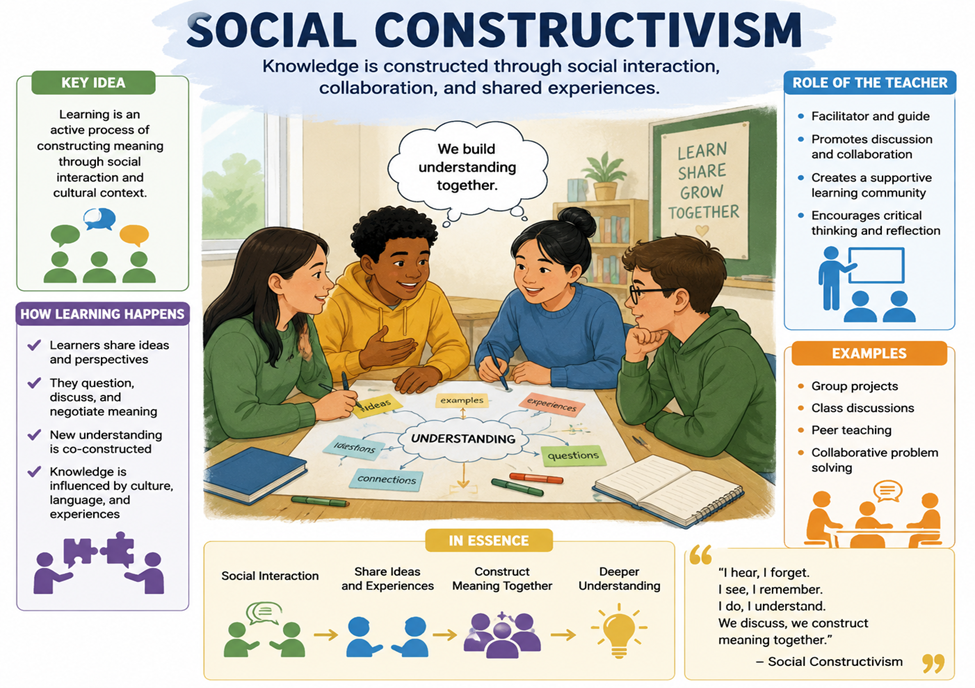
According to social constructivists, learning occurs not only through individual exploration but also through social interactions with others. The process of knowledge construction is seen as a collaborative activity, where social and cultural contexts play a significant role.
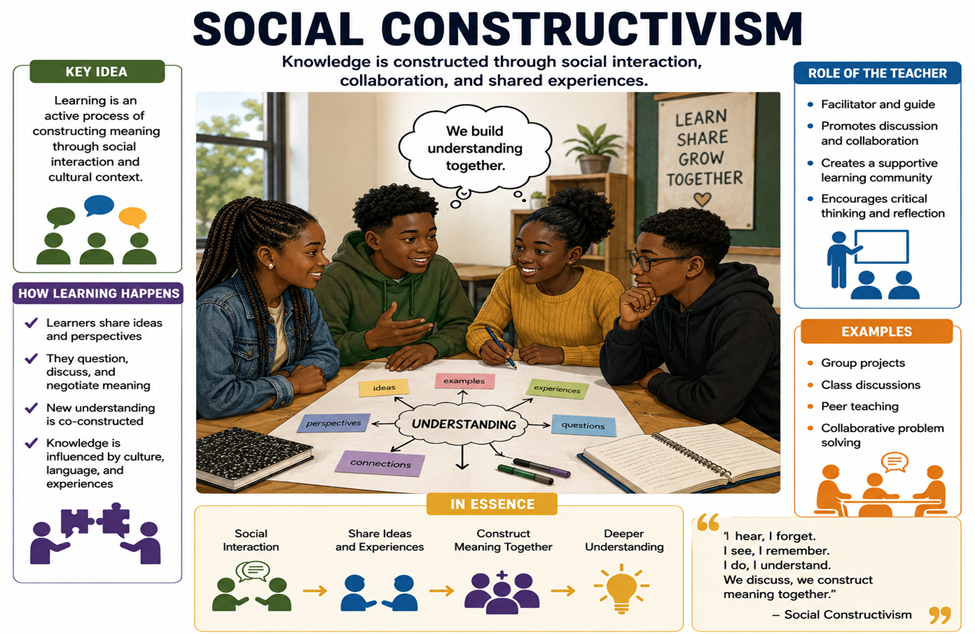
Social constructivism is a learning theory largely associated with Lev Vygotsky, which holds that knowledge is constructed through social interaction and collaboration with others. Rather than viewing learning as an individual process of absorbing information, the theory emphasizes that understanding develops through dialogue, shared experiences, and participation in cultural and social contexts. Language plays a central role, as it is the primary tool through which learners communicate, negotiate meaning, and internalize knowledge.
4.2. Key features of social constructivism
- Social interaction: Learning is viewed as a process that is deeply rooted in social interaction, where dialogue and communication with others (teachers, peers, etc.) help learners build and refine their understanding.
- Cultural context: The cultural background of learners is important in shaping how they understand and interpret the world. Knowledge is viewed as co-constructed through shared experiences.
- Zone of Proximal Development (ZPD): A key concept in social constructivism developed, which refers to the gap between what a learner can do independently and what they can achieve with guidance from a more knowledgeable other, such as a teacher or peer. Learning is most effective when support, often referred to as scaffolding, is provided within this zone and gradually withdrawn as the learner gains competence. Social constructivism emphasizes that learners can achieve higher levels of understanding with the help of more knowledgeable others (teachers, peers).
- Scaffolding: The idea that learners are provided with temporary support from more knowledgeable individuals to help them reach higher levels of understanding, which is gradually removed as learners gain competence.
4.3. Key theorists of social constructivism
1. Lev Vygotsky (1896–1934):
Vygotsky is often considered the father of social constructivism. He focused on the critical role of social interactions and cultural contexts in cognitive development. Key contributions:
§ Zone of Proximal Development (ZPD): Vygotsky introduced the concept of ZPD, which refers to the difference between what a learner can do independently and what they can do with assistance from more knowledgeable individuals (teachers, peers).
§ Scaffolding: This concept involves providing temporary support to learners as they work through challenges, which is gradually removed as they gain competence.
§ Cultural-historical theory: Vygotsky argued that cognitive development is deeply influenced by the social and cultural environment, including language and tools provided by society.
§ Social interaction and language: Vygotsky emphasized the role of language and social dialogue in cognitive development, arguing that learning is fundamentally a social activity.
2. Jerome Bruner (1915–2016):
Bruner's work bridges both constructivism and social constructivism. He extended Vygotsky's ideas and focused on how social interactions can support learning. Key contributions in Social Constructivism): Bruner’s ideas on scaffolding are highly influential in social constructivism, as they stress how more experienced individuals (e.g., teachers, peers) can provide temporary support to help learners reach higher levels of understanding.
3. Albert Bandura (1925–2021)
While not strictly a "social constructivist" in the same sense as Vygotsky, Bandura’s social learning theory greatly influenced social constructivist thought by emphasizing the role of observational learning, imitation, and modeling in the learning process. Key contributions:
- Social Learning Theory: Bandura's theory posits that people learn from one another through observation, imitation, and modeling.
- Self-Efficacy: He emphasized the role of self-efficacy, or the belief in one’s ability to succeed, in learning and motivation.
4.4. Application of social constructivism in the classroom contexts
The application of social constructivism in classroom contexts focuses on fostering an environment where learning is seen as a collaborative process, emphasizing social interaction, cultural context, and active engagement. Teachers who use social constructivist approaches prioritize student-centered learning, where learners build knowledge together and learn through real-world, meaningful interactions. There are several keyways in which social constructivism can be applied in the classroom:
- Engaging learners in collaborative learning such as:
- Group work: Students work in small groups to solve problems, discuss ideas, or complete projects. This encourages peer-to-peer learning and allows students to articulate their understanding, clarify misconceptions, and learn from each other.
- Cooperative learning: Activities like Think-Pair-Share or Jigsaw allow students to collaborate and share insights. In a Jigsaw, each group member becomes an "expert" on a part of a topic and then teaches their peers, making learning a collective effort.
- Peer teaching: More knowledgeable students can assist others by explaining concepts, which reinforces their own understanding while helping others build new knowledge.
- Scaffolding through:
- Teacher support: Teachers provide temporary guidance to students in their learning. This could be in the form of hints, guiding questions, or suggesting resources. The goal is to support students just beyond their current level of ability (within their Zone of Proximal Development, or ZPD), allowing them to independently solve problems over time.
- Gradual release of responsibility: A common instructional method is the "I do, we do, you do" approach, where the teacher first models the task (I do), then does it together with the class (We do), and finally lets the students complete the task on their own (You do).
- Focus on cultural relevance and contextual learning: Connecting lessons to students' cultural backgrounds, experiences, and interests. Teachers can use culturally relevant examples or topics that resonate with the students lived experiences to make learning more meaningful. Teachers design real-world tasks that encourage students to apply their knowledge in ways that mirror how it would be used outside the classroom. This encourages students to understand the social relevance of what they are learning.
- Dialogic teaching: Teachers use open-ended questions to stimulate critical thinking and dialogue among students where students discuss complex ideas and explore multiple perspectives through discussion, rather than simply receiving information from the teacher. The teacher fosters a classroom environment where all students are encouraged to share ideas and build on each other's contributions. This helps learners refine their understanding through dialogue and debate. Teachers encourage students to work together to solve open-ended or complex problems. This type of activity allows students to engage in higher-order thinking and to learn from the viewpoints and expertise of others. For example, students could work on community projects, participate in debates, or conduct experiments that relate to everyday life.
- Inquiry-Based Learning: Social constructivist classrooms often emphasize inquiry-based learning, where students pose questions, investigate topics, and seek solutions through exploration. Teachers guide this process, but students take the lead in constructing knowledge through inquiry.
- Problem-Based Learning (PBL): students work on solving real-world problems. They collaborate with peers, research topics, and discuss potential solutions in groups. The teacher facilitates the process but does not directly provide answers, allowing students to build knowledge and solve problems collaboratively.
- Student-Centered Teaching: In a social constructivist classroom, students take an active role in their learning: Teachers may encourage students to set their own learning goals, self-assess their progress, and reflect on their learning experiences. Offering students some degree of autonomy over their learning process such as choosing projects, topics, or modes of assessment can help them feel more engaged and invested in their education. Instead of traditional teacher-led conferences, students can lead the discussions about their progress, demonstrating how they have constructed their knowledge over the course of the term.
- Technology integration: Use of collaborative tools. Online platforms (e.g., Google Docs, Padlet, Edmodo) allow students to collaborate in real time, providing opportunities for peer feedback, joint creation of documents, and shared learning experiences. Discussion forums and online learning communities: Social constructivism can also extend beyond the physical classroom with virtual collaboration. Discussion boards, video conferences, and collaborative online research activities allow students to engage with peers and experts from around the world, broadening their learning experiences.
- Reflection: Teachers encourage students to engage in reflective practices where they consider how they constructed knowledge, what they learned, and how they interacted with peers. After completing collaborative tasks, groups can discuss their learning process, including what strategies worked, what challenges they faced, and how they overcame them.
5. Social Learning Theory
Activity: Answer the following questions:
1. Can you recall a time when you learned something just by watching someone else?
2. What have you learned from that person?
5.1. Description of social Learning theory

Social Learning Theory (SLT), now called Social Cognitive Theory, was developed by the Canadian American psychologist Albert Bandura in the 1960s. The theory emphasizes the role of observation, imitation and modeling in the learning process. It explains how people learn new behaviors, skills, and attitudes by observing and imitating others.
People can learn new behaviors and acquire knowledge not only through direct experience but also by observing others in their environment. According to the SLT, much of human learning occurs in a social context, and individuals learn by observing the behaviors of others, retaining the observed information, and later replicating the behavior. This theory integrates cognitive, behavioral, and environmental influences, suggesting that learning is a reciprocal interaction between these three factors. According to Bandura (1986), much of human learning is more efficiently learned directly from a model. For instance, if students see their friend rewarded for a good work done, they may work hard so that they are also rewarded.
5.2. Elements of Social Learning Theory
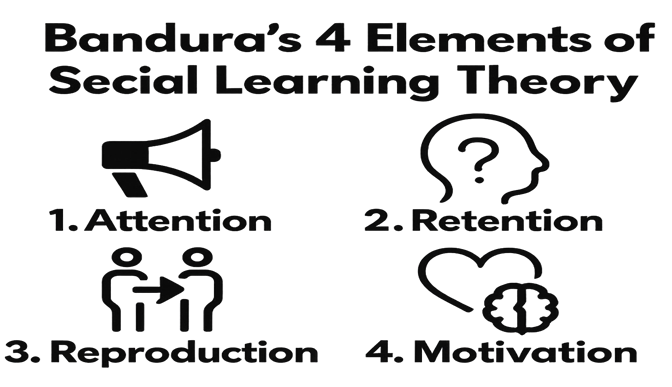
- Attention: The first process in social learning is paying attention to the model. The learner must pay attention to the model. This enables the observer to determine which aspects of the modelled information are relevant or irrelevant. Factors that enhance attention include the model’s characteristics (e.g., attractiveness, expertise), the complexity of the behavior being demonstrated, and the observer’s motivation. In the classroom situation, the teacher gains students’ attention by presenting clear information and motivating them as their model.
- Retention: involves storing information in memory for later use. For observational learning to be effective, the learner must be able to remember the behavior and the conditions under which it was performed. In classroom, after gaining students’ attention, a teacher can model the behaviour he/she wants students to imitate and then give them chance to practice
- Reproduction: After attending to and retaining modeled behaviour, the observer is ready to produce the behaviour or after observing and remembering the behavior, the learner must have the ability to replicate or reproduce the behavior. This requires both physical capability and mental practice.
- Motivation: Motivation is critical for learning through observation. If learners perceive that the modeled behavior will lead to positive outcomes (rewards) or avoid negative outcomes (punishments), they are more likely to imitate the behavior. Students will imitate a model because they believe that doing so will increase their chance of being reinforced. This motivation is influenced by reinforcement and punishment, as well as the learner’s own goals and values. Both direct reinforcement (rewards for performing a behavior) and vicarious reinforcement (seeing others being rewarded for their behavior) play important role in observational learning. Vicarious punishment (observing others being punished for their actions) can prevent the observer from imitating the behavior.
Ø Vicarious reinforcement occurs when an individual observes someone else being rewarded for a behavior, and as a result, they are more likely to imitate that behavior themselves. People are more likely to repeat behaviors they see being rewarded in others. Example: If a child observes their classmate receiving praise for answering a question correctly, they are more likely to try answering questions in the future to receive similar positive reinforcement (praise or recognition). In this way, the reward that the other person (the model) receives indirectly influences the observer to behave in a similar way.
Ø Vicarious punishment occurs when an individual observes someone else being punished for a behavior and is then less likely to engage in that behavior themselves. People are less likely to repeat behaviors they see being punished in others. Example: If a student sees a classmate being reprimanded or losing privileges for being disruptive in class, they might be less likely to engage in disruptive behavior themselves, knowing it could lead to negative consequences. In this case, the punishment that the other person (the model) experiences serve as a deterrent for the observer.
In short, vicarious reinforcement encourages behavior by observing rewards. Vicarious Punishment discourages behavior by observing consequences or punishment. Both vicarious reinforcement and vicarious punishment show that learning doesn’t only happen through direct experience. Observation plays a crucial role in how we learn from others, whether by mimicking their rewarded behaviors or avoiding those that lead to negative consequences. This principle is particularly important in social contexts (like classrooms, homes, or social media), where people, especially children, are constantly observing others’ actions and the results those actions bring.
5.3. Application of social learning theory in the classroom
A teacher can apply social learning theory by doing the following:
- Modeling desired behavior: Teachers can serve as role models for students by demonstrating the behaviors they wish students to adopt. For example, a teacher might model respectful communication during a class discussion, demonstrating how to listen attentively and respond politely. Students are likely to imitate these behaviors. Teachers may model problem-solving strategies for solving a difficult math problem on board. By demonstrating the process step- by-step, students learn how to approach similar problems.
- Use of peer learning: Peer interactions play a significant role in social learning. Students can observe and learn from one another during group activities or collaborative learning tasks. Pairing stronger students with weaker ones encourages positive role modeling and provides opportunities for observational learning. For instance, during group projects, students can observe and learn from their peers as they work together on solving problems, performing experiments, or presenting findings. This interaction fosters the exchange of ideas and encourages skill development through observation.
- Use of vicarious reinforcement: Teachers can use vicarious reinforcement by rewarding students who exhibit desired behaviors. By doing so, other students will be motivated to imitate those behaviors, expecting similar positive outcomes. For example, a teacher may praise or reward a student who consistently contributes thoughtful ideas during a discussion. Other students who observe this reinforcement may be motivated to participate more actively in future discussions, hoping for similar praise or recognition.
- Use of vicarious punishment in classroom behavior management to discourage negative behavior by modeling appropriate behaviors and addressing misbehavior through observation. If a student sees a peer being reprimanded for inappropriate behavior, they may be less likely to engage in similar behavior themselves. Example: If a student is disruptive in class, the teacher can intervene by addressing the behavior calmly while reinforcing positive behavior in others. Seeing this can deter other students from acting out in a similar manner.
- Observing models of success: Teachers can introduce students to successful models, either through real-life role models, guest speakers, or media examples. Students can observe how these individuals approach challenges and learn from their strategies and behaviors. Example: A history teacher might show video clips of famous leaders, such as Martin Luther King Jr. or Mahatma Gandhi, demonstrating their leadership and public speaking skills. Students can then reflect on the qualities that made these figures successful and try to model those qualities in their own behavior.
- Encouraging self-reflection and self-evaluation: Teachers can encourage students to reflect on their behavior and the behavior of others. Self-reflection enhances self-regulation, which is a key part of social learning. Self-regulation refers to the ability to control one’s emotions, thoughts, and behaviors in the face of temptations and impulses, to achieve a goal or meet a standard. By reflecting on past actions, students can evaluate whether they want to replicate certain behaviors and make improvements. Example: after completing a collaborative project, a teacher may ask students to reflect on their individual contributions and how well they work with their peers. This encourages students to think critically about their actions and promotes self-improvement.
- Use of positive reinforcement: Teachers can use praise or rewards to encourage desirable behaviors, making it more likely that students will repeat those behaviors. Example: When a student displays good behavior or achieves a goal, the teacher can offer verbal praise or tangible rewards (e.g., stickers, extra privileges). This positive reinforcement increases the likelihood of the student continuing to display the same behavior.
- Utilizing technology for modeling and observation: Technology can be used in classrooms to expose students to a variety of models. Educational videos, simulations, and virtual peer interactions can provide opportunities for students to observe behaviors in diverse contexts. Students can then replicate these methods in their own experiments. Example: In a science class, the teacher can show a video of a scientist conducting an experiment, providing students with a model of how to carry out scientific investigations. Students can then replicate these methods in their own experiments.
- Use of role-playing and simulation: Role-playing activities allow students to act out behaviors and observe how these behaviors are performed in different situations. Role-play exercises encourage students to practice social skills, problem-solving, and conflict resolution. Example: in a language class, students could engage in role-playing activities where they practice conversations in the target language. This allows them to observe effective communication strategies and apply them in their own dialogues.
Activity: Choose a lesson topic from the subjects you will teach, clarify how you will apply each of the four elements of social learning theory.
6. Sociocultural theory
Activity:
1. 1. Have you ever worked together with your peers?
2. 2. What were you doing?
3. How did working together help you succeed?” or “What did you learn from your peers?
6.1. Description of Sociocultural theory
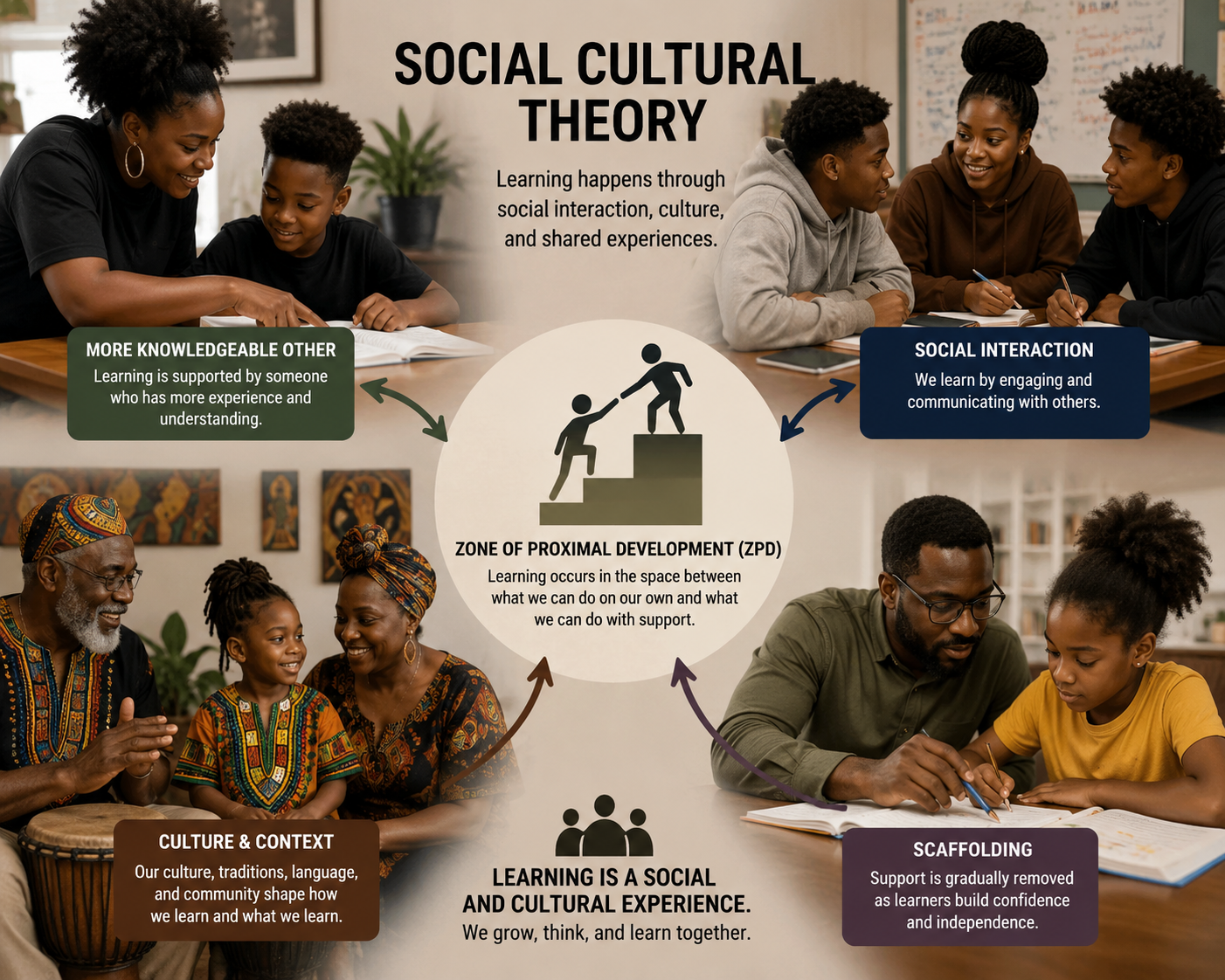
This theory is most famously associated with Lev Vygotsky (1896-1934), a Russian psychologist who believed that cognitive development is deeply embedded in the social and cultural contexts in which a person is situated.
The theory emphasizes the role of social environments, cultural practices, and tools (especially language) in shaping how individuals think, learn, and construct knowledge. Sociocultural theory is a framework for understanding how social interaction, culture, and language influence learning and cognitive development.
According to sociocultural theory, learning is a social process, and cognitive functions develop through interactions with more knowledgeable others, such as teachers, peers, and family members.
6.2. Key concepts of sociocultural theory
A. Social interaction and cognitive development:
Vygotsky believed that cognitive development is largely driven by social interactions. Learning is not an isolated process but occurs within a social context where individuals collaborate, discuss, and exchange ideas with others. Through these interactions, individuals internalize cultural knowledge and develop higher-level thinking skills. Vygotsky argued that cognitive functions (e.g., thinking, problem-solving, memory) are initially developed through social interactions with others, particularly more knowledgeable individuals such as parents, teachers, or peers. According to this theory, children learn from the guidance and support of others, which helps them internalize cultural tools and knowledge.
According to Vygotsky, learning appears twice: first on the social level and then on the individual level; i.e. between people (interpsychology) and inside the child (intrapsychology). Development cannot be separated from its social context. Vygotsky focused on a child not as an individual but as a product of social interaction, especially with adults (parents, teachers).
B. Zone of Proximal Development (ZPD):
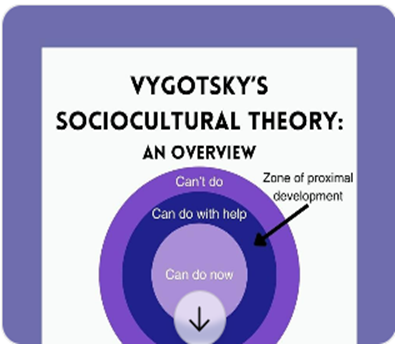
The zone of proximal development is one of the central concepts in sociocultural theory. It refers to the range of tasks that a learner can perform with the help of more knowledgeable others, such as teachers or peers, but cannot yet perform independently. The ZPD represents the difference between what a learner can do alone (independent performance) and what they can do with assistance (assisted performance). Learning occurs most effectively within the ZPD, as learners are challenged just beyond their current abilities but still within their potential capacity to achieve with help.

The distance between actual and potential knowledge
The concept of the distance between actual and potential knowledge is closely related to Lev Vygotsky’s concept of the Zone of Proximal Development (ZPD), which is the space between what a learner can do alone and what they can do with guidance.
- Actual knowledge refers to the information, skills, and understanding that a learner has already mastered or can do independently. It represents the learner's current cognitive abilities and what they can perform or accomplish without assistance. Example: A student who can independently add and subtract numbers or solve simple math problems has mastered basic arithmetic skills and has actual knowledge in that domain.
- Potential knowledge refers to what a learner is capable of understanding or achieving but cannot yet do independently. It represents the learner’s capacity to acquire new knowledge or skills with the assistance of a more knowledgeable person (such as a teacher or peer). Example: A student who is currently unable to solve a complex algebraic equation but has the capacity to do so with some guidance from a teacher would be seen as having potential knowledge in algebra.
The distance between actual and potential knowledge illustrates the gap between what a learner can do on their own or what a learner currently knows (actual knowledge) and what they can accomplish with guidance or what they can potentially learn with the assistance of a more knowledgeable person such as a teacher or peer (potential knowledge). That gap forms the basis for significant cognitive growth and learning. By understanding and leveraging this distance, teachers can provide effective mediation, guiding learners to new levels of understanding and ability, thus fostering growth and development.
The difference between actual knowledge (what the learner can do independently) and potential knowledge (what the learner can do with help) is the ZPD. Vygotsky emphasized that learning occurs in the ZPD, where tasks are challenging but achievable with guidance.
The process of helping learners progress from actual knowledge to potential knowledge is known as Mediated Learning. Through the interaction with a more knowledgeable person (teacher, mentor, peer), learners are given the tools, prompts, and support necessary to extend their abilities
The temporary support provided to learners to bridge the gap between their actual and potential knowledge referred to Scaffolding. The support is gradually reduced as the learner gains independence and mastery of the task.
Example of the relationship between actual and potential knowledge
Let’s consider a high school student learning calculus:
- Actual knowledge: The student knows basic algebra and trigonometry, which includes solving equations and working with functions. This knowledge is sufficient for solving simple math problems.
- Potential knowledge: The student is capable of understanding complex calculus concepts such as limits, derivatives, and integrals, but cannot do so independently yet. With targeted guidance from a teacher, the student could eventually solve calculus problems.
- Mediation in action: The teacher helps the student by explaining the concepts of calculus step by step, offering practice problems, and providing support when the student struggles with new ideas. As the student begins to grasp the concepts, the teacher reduces the level of assistance, allowing the student to work more independently.
- End result: Through mediation, the student’s actual knowledge expands to include the concepts of calculus, and the gap between their actual and potential knowledge diminishes. Eventually, the student can solve calculus problems independently, demonstrating their growth.
C. Scaffolding
It refers to the support provided by a more knowledgeable other to help a learner complete a task within their ZPD. Scaffolding is temporary and is gradually removed as the learner becomes more competent and can perform the task independently. Examples of scaffolding include teachers providing hints, asking guiding questions, or breaking down tasks into manageable steps. As the learner gains mastery, the support is faded.
D. Cultural tools
The theory highlights the importance of cultural tools (language, symbols, technology, etc.) in shaping how we think and learn. Vygotsky placed a strong emphasis on language as a key cultural tool for cognitive development i.e. for thinking and problem-solving. He believed that language is the primary means through which individuals interact with others and make sense of the world. Vygotsky argued that children learn to think and solve problems through the language and other tools provided by their culture. Through language, individuals internalize cultural norms, values, and knowledge. For example, a child learns the cultural meanings of words, rules of conversation, and problem-solving strategies through social interactions, which shape their cognitive development.
Vygotsky also highlighted the importance of private speech (talking to oneself), which children often use as a tool for self-regulation and problem-solving. As children develop, private speech becomes internalized and forms the basis for inner thought.
E. Cultural tools and Mediated Learning
According to sociocultural theory, cultural tools (e.g., language, symbols, books, computers, and other technological or social tools) mediate cognitive development. These tools help individuals process information, communicate, and engage in problem-solving. For example, mathematical symbols, written language, and calculators are all cultural tools that enable individuals to think in ways that would not be possible without them.
F. Social and cultural contexts
Sociocultural theory underscores the significance of the social and cultural environment in shaping learning. The theory posits that learning is not just an individual process but is deeply influenced by the cultural and social contexts in which a person lives. The norms, values, and practices of a particular culture impact how people think, communicate, and learn. For example, the educational practices, social interactions, and cultural expectations within a particular community or society influence the cognitive development of individuals in that community.
6.3. Classroom applications of Sociocultural Theory
- Collaborative Learning: Sociocultural theory advocates for learning environments where students work together in groups, sharing knowledge and solving problems. This approach fosters social interaction and helps learners construct meaning through collaboration. Peer tutoring, group projects, and cooperative learning activities are examples of ways to apply sociocultural theory in the classroom. In these settings, students help each other develop skills and knowledge, learning through social interaction.
- Guided participation: Teachers act as guides or facilitators, providing support for students within their ZPD. Teachers might model tasks, provide hints, or ask probing questions to help students navigate learning challenges. Apprenticeship learning or project-based learning (where students engage in real-world tasks with the guidance of more experienced mentors or peers) is another practical application of sociocultural theory.
- Scaffolded instruction: Teachers can offer support through scaffolding techniques by breaking down complex tasks into smaller, manageable parts and providing the necessary resources for students to complete tasks. Over time, the support is gradually withdrawn as students gain independence.
- Culturally responsive teaching: In the classroom, sociocultural theory emphasizes the importance of considering students’ cultural backgrounds in the learning process. Teachers should incorporate culturally relevant materials, strategies, and content that reflect the diverse backgrounds of their students. Teachers can recognize and build on the cultural knowledge that students bring to the classroom, such as knowledge from home or community experiences, to enhance their learning.
- Use of language in learning: Teachers can encourage students to use language as a tool for thinking and problem-solving. This could include activities like think-alouds, where students verbalize their thought processes, or peer discussions, where students engage in dialogue to clarify ideas and reach understanding.
- Use of technology-enhanced learning: Modern educational technologies (e.g., online learning platforms, collaborative tools like Google Docs) can support sociocultural principles by enabling students to collaborate, communicate, and learn from others beyond the classroom. Online forums, video conferences, and interactive learning tools help facilitate social interaction, where students can engage with peers and mentors in meaningful ways.
Activity: Discuss the challenges you may encounter while implementing sociocultural theory in classroom settings.
7. Connectivism as a Theory of Learning
Activity:
1.
- Think of something important you learned recently outside the classroom.
- How did you learn it? Or Which sources have you used to learn that thing?
- Write your answers using the following “learning network map”. In the center write: How I learned …… and in the rectangle, write the answers.

- In a group of five, share, one by one, your responses and connect your answers using arrows and labels on the learning network map.
7.1. Description of connectivism
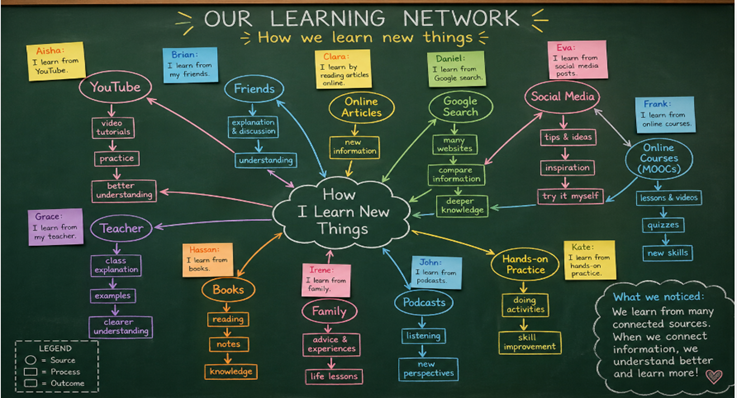
Referring to the previous activity, as students share their answers, a web of interconnected learning sources begins to form. This makes the concept of connectivism more concrete by showing that knowledge is distributed across many sources and grows through connections, a core idea developed by George Siemens. The “learning network map” is visualized as a growing web of interconnected nodes with the answers from different students writing what and how they learnt new things.
Connectivism is a contemporary learning theory developed by George Siemens (2004) and further advanced by Stephen Downes (2005) in the early 21st century. It emerged in response to the limitations of traditional theories such as behaviorism, cognitivism, and constructivism in explaining learning in a digital, networked world. Connectivism is built on the idea that digital technology brings people together and creates new learning opportunities. The theory promotes the idea that learning can successfully happen through digital channels, including social media, forums, videos, and blogs. It posits that the use of digital technology helps to solve a problem and, in turn, deepens the understanding of a topic.
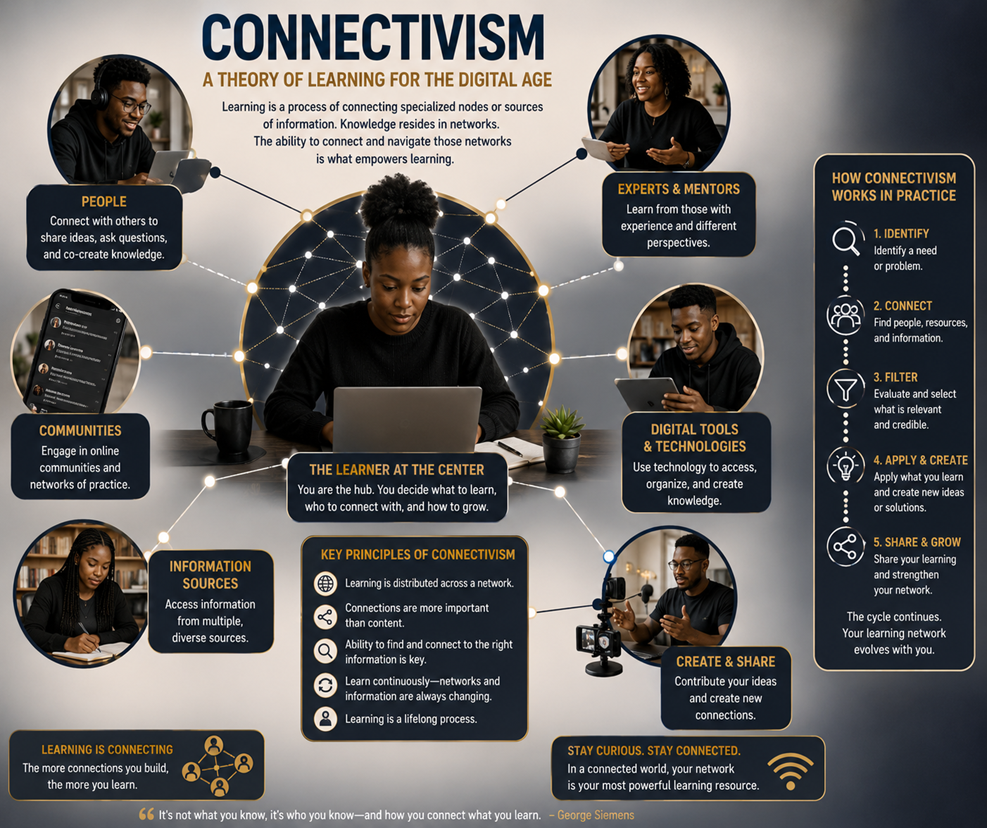
According to Siemens (2008), connectivism is a learning theory comprised of different series of nodes to connect hundreds of networks to facilitate synchronous and asynchronous learning (Dunaway, 2011). These connections provide individuals with direct access to reliable information from millions of sources to duplicate, reproduce, and share within their social networks, and to delete, critique, and discard inaccurate, irrelevant, and unreliable information
Connectivism is a learning theory designed to explain how individuals acquire knowledge in the digital age, emphasizing the role of technology in shaping learning processes. Unlike previous theories that focused on individual learning experiences, connectivism recognizes the interconnectedness facilitated by digital platforms such as the Internet, social networks, and various applications. It posits that knowledge is no longer confined to personal experiences or passive absorption but is actively constructed through collaboration and interaction with others.7
George Siemens (in 2004) and Stephen Downes (in 2005) said connectivism begins when an individual turns to digital technology to solve a problem. This can include actions such as googling a question, texting a friend, or searching for topical social media content.
7.2. What are nodes and links in connectivism?
To understand connectivism, you have to think like a network engineer. The theory of connectivism relies heavily on the metaphor of a network with nodes and links.
- Nodes: A node can be anything that holds information. This could be a person, a book, a website, a database, a video, or an organization. In a classroom setting, every student is a node, as is the teacher and the textbook.
- Links: A link is the connection between these nodes. Learning happens when you create a link. For example, when a student follows an expert on social media, they create a link to a new node.
The strength of your learning depends on the diversity and quality of your network. If your nodes are all similar (e.g., you only get news from one website), your network is weak. If your nodes are diverse and interconnected, your capacity for learning and problem-solving expands significantly.
Connectivism aligns strongly with 21st-century skills, including digital literacy, critical thinking, communication, and collaboration. It is particularly relevant in contexts where technology is increasingly integrated into education systems. However, its application requires careful consideration of challenges such as unequal access to technology, varying digital competencies among learners, and the need for teacher training.
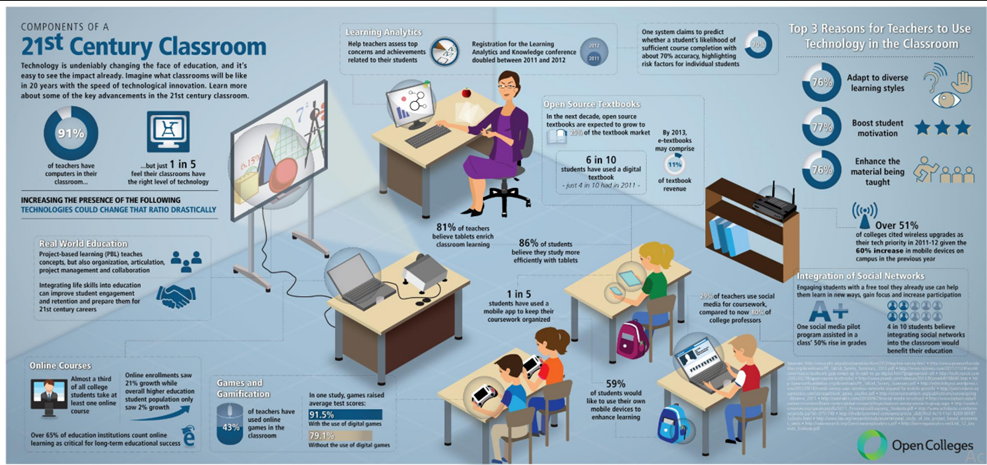
7.3. Key principles of connectivism
George Siemens mapped out guiding principles that redefine how learning is understood:
- Learning and knowledge reside in networks. These networks consist of nodes, which may include individuals, digital platforms, databases, or organizations. Learning occurs when connections between these nodes are formed and strengthened.
- Learning is a process of connecting. When we build relationships with colleagues, we open ourselves up to new skills, thoughts, and ideas we might not otherwise have access to.
- Nurturing and maintaining connections are needed to facilitate continual learning. Collaborative social interaction brings people together and forms a long-term learning environment.
- Ability to see connections between fields, ideas, and concepts is a core skill. We must learn how to build a bridge to connect point A to point B. That bridge itself is a new learning opportunity.
- Accurate, up-to-date knowledge is the intent of all connectivist learning. When we work together, our understandings are constantly being reinforced and updated.
- Diversity of opinions and sources is essential. Learning is enriched when individuals engage with multiple perspectives across networks. Perspectives from a variety of sources deepen our understanding.
- The capacity to know more is more critical than what is currently known. In rapidly changing knowledge environments, the ability to access and update information becomes more valuable than what we know today. As Siemens says: “Our ability to learn what we need for tomorrow is more important than what we know today.”
- Learning can reside in non-human appliances, such as computers, artificial intelligence systems, and online repositories Learners may store information in a digital way, like in an app, social media post, or video. Similarly, a community of learners may store information in a database or forum. This reflects the increasing role of technology in storing and generating knowledge.
- Decision-making is itself a learning process. Learners must evaluate information, determine its relevance, and adapt to new knowledge, recognizing that what is correct today may be outdated tomorrow. What we know today may change tomorrow. We must accept that our knowledge will need to continuously evolve as new understandings present themselves.
7.4. Characteristics of learning in connectivism
Learning within this theory is dynamic and ongoing. It is characterized by:
- Continuous updating of knowledge
- Use of digital technologies and online platforms
- Collaboration and interaction across global networks
- Emphasis on critical thinking and information evaluation
- Informal and self-directed learning pathways
Rather than being teacher-centered, learning becomes network-centered, where the learner actively participates in knowledge creation and sharing
7.5. Classroom applications of connectivism

In classroom practice, connectivism shifts the role of both teachers and learners and integrates technology meaningfully into teaching and learning.
Integration of digital learning platforms: Teachers can incorporate platforms such as Google Classroom, Moodle, or WhatsApp to extend learning beyond the physical classroom. These platforms enable learners to access resources, participate in discussions, and collaborate asynchronously. For instance, teachers can use social media platforms like X (formerly Twitter) or LinkedIn to connect students with industry experts, authors, or other classrooms around the world. Instead of writing a report that only the teacher reads, students might blog about their learning or create YouTube videos, allowing them to contribute to the global network of knowledge.
Networked and collaborative learning: Learners must be engaged in group tasks that require interaction with peers, experts, or online communities. For instance, students may participate in online forums, co-author documents, or engage in virtual discussions, thereby building knowledge collectively.
Emphasis on information literacy: Teachers must guide students in evaluating the credibility, relevance, and accuracy of information found online. This is critical in an era of abundant and sometimes unreliable information.
Use of Open Educational Resources (OERs): Students are encouraged to explore diverse sources such as videos, podcasts, blogs, and academic websites. This broadens their exposure and supports self-directed learning.
Teacher as facilitator and connector: The teacher’s role evolves from being the sole source of knowledge to a facilitator who helps learners make meaningful connections between ideas, resources, and people.
Personalized and self-directed learning: Learners take responsibility for their own learning paths, selecting tools, resources, and networks that suit their needs and interests.
Real-world and lifelong learning orientation: Classroom activities must be linked to real-life contexts. Students may follow current events, engage with global issues, or interact with professionals online, fostering lifelong learning habits.
In short, connectivism represents a shift from traditional, content-centered learning to network-based, technology-enhanced learning. It acknowledges that in a rapidly evolving digital world, the ability to connect, adapt, and learn continuously is more important than static knowledge. In classroom practice, this translates into collaborative, technology-supported, and learner-driven approaches that prepare students for lifelong learning.
Activity: Discuss the challenges you may encounter while implementing connectivism learning theory in classroom settings.