
Kindly engage with the content of unit 3 and do all related activities.
5. Social Learning Theory
5.2. Elements of Social Learning Theory
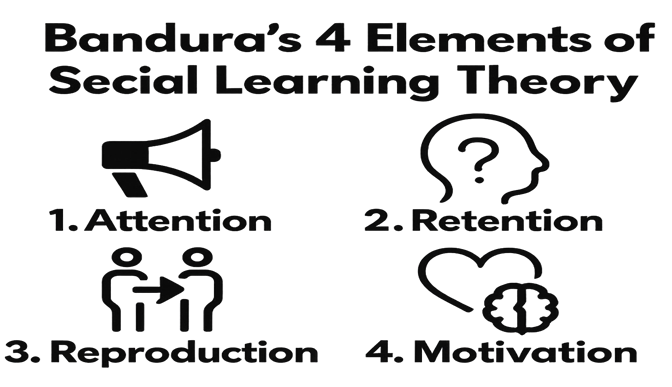
- Attention: The first process in social learning is paying attention to the model. The learner must pay attention to the model. This enables the observer to determine which aspects of the modelled information are relevant or irrelevant. Factors that enhance attention include the model’s characteristics (e.g., attractiveness, expertise), the complexity of the behavior being demonstrated, and the observer’s motivation. In the classroom situation, the teacher gains students’ attention by presenting clear information and motivating them as their model.
- Retention: involves storing information in memory for later use. For observational learning to be effective, the learner must be able to remember the behavior and the conditions under which it was performed. In classroom, after gaining students’ attention, a teacher can model the behaviour he/she wants students to imitate and then give them chance to practice
- Reproduction: After attending to and retaining modeled behaviour, the observer is ready to produce the behaviour or after observing and remembering the behavior, the learner must have the ability to replicate or reproduce the behavior. This requires both physical capability and mental practice.
- Motivation: Motivation is critical for learning through observation. If learners perceive that the modeled behavior will lead to positive outcomes (rewards) or avoid negative outcomes (punishments), they are more likely to imitate the behavior. Students will imitate a model because they believe that doing so will increase their chance of being reinforced. This motivation is influenced by reinforcement and punishment, as well as the learner’s own goals and values. Both direct reinforcement (rewards for performing a behavior) and vicarious reinforcement (seeing others being rewarded for their behavior) play important role in observational learning. Vicarious punishment (observing others being punished for their actions) can prevent the observer from imitating the behavior.
Ø Vicarious reinforcement occurs when an individual observes someone else being rewarded for a behavior, and as a result, they are more likely to imitate that behavior themselves. People are more likely to repeat behaviors they see being rewarded in others. Example: If a child observes their classmate receiving praise for answering a question correctly, they are more likely to try answering questions in the future to receive similar positive reinforcement (praise or recognition). In this way, the reward that the other person (the model) receives indirectly influences the observer to behave in a similar way.
Ø Vicarious punishment occurs when an individual observes someone else being punished for a behavior and is then less likely to engage in that behavior themselves. People are less likely to repeat behaviors they see being punished in others. Example: If a student sees a classmate being reprimanded or losing privileges for being disruptive in class, they might be less likely to engage in disruptive behavior themselves, knowing it could lead to negative consequences. In this case, the punishment that the other person (the model) experiences serve as a deterrent for the observer.
In short, vicarious reinforcement encourages behavior by observing rewards. Vicarious Punishment discourages behavior by observing consequences or punishment. Both vicarious reinforcement and vicarious punishment show that learning doesn’t only happen through direct experience. Observation plays a crucial role in how we learn from others, whether by mimicking their rewarded behaviors or avoiding those that lead to negative consequences. This principle is particularly important in social contexts (like classrooms, homes, or social media), where people, especially children, are constantly observing others’ actions and the results those actions bring.