
Kindly engage with the content of unit 3 and do all related activities.
1. Behaviourism
1.2. Classical conditioning or learning by association
Classical conditioning is a learning process first described by Ivan Pavlov, a Russian physiologist. It involves learning through association, where a neutral stimulus becomes associated with a meaningful stimulus, eventually triggering a similar response: an association is made between two stimuli which are linked together to produce a new learned response. One stimulus is neutral and the other evokes a natural response. After learning the association, the neutral stimulus elicits the conditioned response.
A. Pavlov’s experiment
In his experiments, Pavlov gave the food=meat (Unconditioned Stimulus/ US) to a dog, and the dog salivated (Unconditioned Response/UR). Pavlov paired the presentation of food with the sound of a bell (Unconditioned Stimulus/ US + Neutral Stimulus/NS) and the dog salivated (Unconditioned Response/UR). After several pairings (of the sound and the food), the dogs began to salivate as soon as they heard the sound. The sound of the bell (Conditioned Stimulus/ CS) caused the dog to salivate even in the absence of food (Conditioned Response/CR). The dog had learned to associate the sound with the food that followed, or the dog had learned to salivate to a new stimulus (the sound of the bell). This is conditioning. Even without seeing the food, the dogs began to salivate at the ringing of the bell. The dog had associated the ringing of the bell with the arrival of the food and reacted accordingly (salivated).
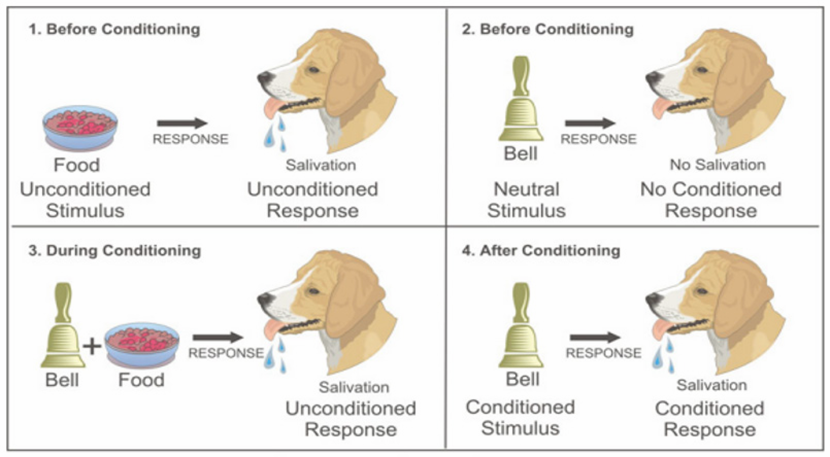
Illustration of classical conditioning (REB, 2020, p. 185)
B. Principles of classical conditioning
The principles of classical conditioning include extinction, spontaneous recovery, stimulus generalization, and stimulus discrimination.
B.1 Extinction
After the conditioning had taken place, Pavlov continued his experiment and presented the sound of the bell repeatedly but without presenting the food afterward. The behavior (salivation) rapidly decreased: the dogs salivated less and less to respond to the sound of the bell, and eventually the sound did not elicit salivation at all. The dog stopped salivating with the sound of the bell because there was no reinforcement (food). This behavior is referred to as extinction: reduction in responding that occurs when the conditioned stimulus is presented repeatedly without the unconditioned stimulus.
B.2 Spontaneous recovery
Pavlov found that, after a pause, ringing again the bell elicited salvation, although to a lesser extent than before extinction took place. The increase in responding to the CS following a pause after extinction is known as spontaneous recovery, that is, the reminiscence of earlier learning. Although at the end of the first extinction period the CS was no longer producing salivation, the effects of conditioning had not entirely disappeared.
B.3 Stimulus generalization
Pavlov also experimented with presenting new stimuli that were similar, but not identical to, the original conditioned stimulus. He found that dogs also salivated upon experiencing similar stimulus, a process known as stimulus generalization: the tendency to respond to stimuli that resembles the original conditioned stimulus.
The ability to generalize has important significance: If we eat some red berries and they make us sick, it would be a good idea to think twice before we eat some purple berries. Although the berries are not exactly the same, yet they are similar and may have the same negative properties.
B.4 Stimulus discrimination
The opposite of generalization is stimulus discrimination: the tendency to respond differently to stimuli that are similar but not identical. Pavlov’s dogs quickly learned, for example, to salivate when they heard the specific tone that had preceded food, but not upon hearing similar tones that had never been associated with food.
Discrimination is also useful: if we do try purple berries, and if they do not make us sick, we will be able to make the distinction in the future. And we can learn that although the two people in our class, Moses and Peter, may look alike, they are, however, different people with different personalities.
C. Application of classical conditioning in classroom settings
The teachers can apply classical conditioning in the classroom by doing the following:
- Avoid presenting painful experiences (stimuli) to learners as they may learn (become conditioned) to fear or hate school. For example, a teacher who frequently humiliates a learner for giving a wrong answer may cause that learner to fear participation or even dislike attending school. Instead, correcting mistakes in a supportive and respectful manner helps maintain a positive learning environment.
- Identify the most important aspects of the lesson and emphasize them so that learners can discriminate or differentiate them. For instance, during a science lesson, a teacher may highlight and repeatedly stress the formula and key terms, while using diagrams or bold writing on the board to help learners focus on what matters most.
- Give learners more opportunities to use and repeat the knowledge they have acquired. For example, after teaching a new mathematical concept, a teacher can provide multiple practice exercises, group work activities, or short quizzes, allowing learners to apply the concept several times in different contexts until it becomes familiar.
- Reinforce desired behaviors and punish undesired ones. For instance, praise students after they answer questions correctly. Over time, students may begin to associate the teacher’s specific praise with positive reinforcement, making them feel more engaged and eager to participate. This helps create an atmosphere where students are conditioned to feel positive emotions toward classroom activities.
- Encourage desirable behaviors by associating those behaviors with positive stimuli: For example, a teacher can offer verbal praise (UCS) when a student raises their hand before speaking (NS). Over time, the student will begin to associate raising their hand (CS) with praise (CR), leading to more frequent hand-raising during class discussions.
- Reduce negative behaviors through extinction: If a student feels anxious when called on to speak in class (due to negative past experiences), the teacher can work to reduce this fear by consistently praising or encouraging the student when they participate, eventually removing the negative association with speaking in front of the class.
- Help students develop positive emotional responses toward learning activities: Examples, a teacher who consistently provides positive feedback when a student participates in discussions can condition the student to feel a sense of pride and confidence when engaging in those activities. A student who initially feels nervous about presenting in front of the class might begin to associate the act of speaking in front of others with praise and recognition from the teacher. Over time, the student may experience positive emotions toward public speaking, due to the conditioned emotional response.
- Using music to enhance focus: Teachers can use background music or specific sounds as neutral stimuli (NS) and pair them with productive learning experiences, turning the sound or music into a conditioned stimulus (CS). Over time, students may become conditioned to focus or feel more relaxed when they hear the music or sound. For instance, a teacher may play soft classical music while students are doing independent work. Over time, the students will associate the music with concentration and productivity, leading them to feel more focused whenever they hear it.