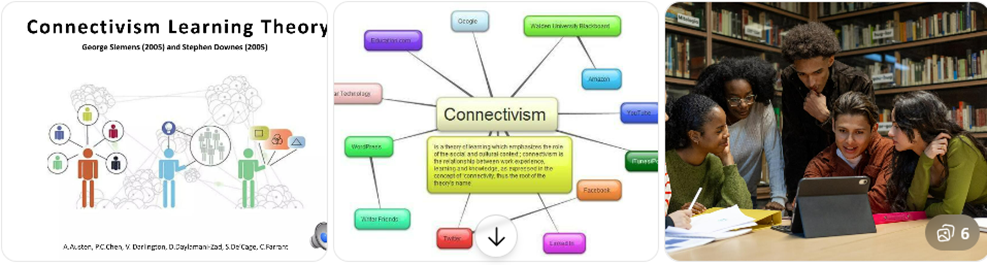
Resources for unit 3
7. Connectivism as a Theory of Learning
7.1. Description of connectivism
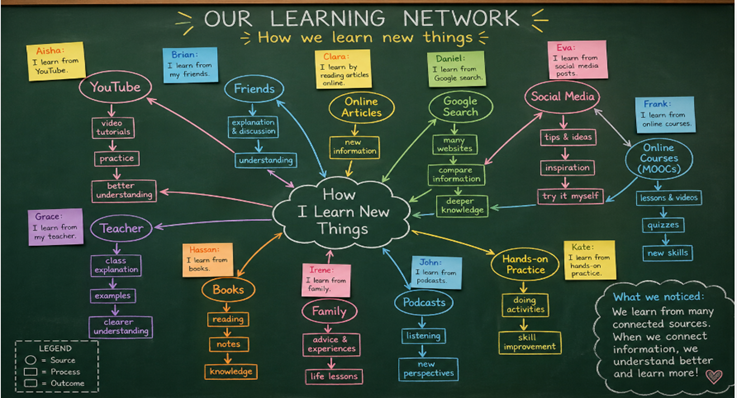
Referring to the previous activity, as students share their answers, a web of interconnected learning sources begins to form. This makes the concept of connectivism more concrete by showing that knowledge is distributed across many sources and grows through connections, a core idea developed by George Siemens. The “learning network map” is visualized as a growing web of interconnected nodes with the answers from different students writing what and how they learnt new things.
Connectivism is a contemporary learning theory developed by George Siemens (2004) and further advanced by Stephen Downes (2005) in the early 21st century. It emerged in response to the limitations of traditional theories such as behaviorism, cognitivism, and constructivism in explaining learning in a digital, networked world. Connectivism is built on the idea that digital technology brings people together and creates new learning opportunities. The theory promotes the idea that learning can successfully happen through digital channels, including social media, forums, videos, and blogs. It posits that the use of digital technology helps to solve a problem and, in turn, deepens the understanding of a topic.
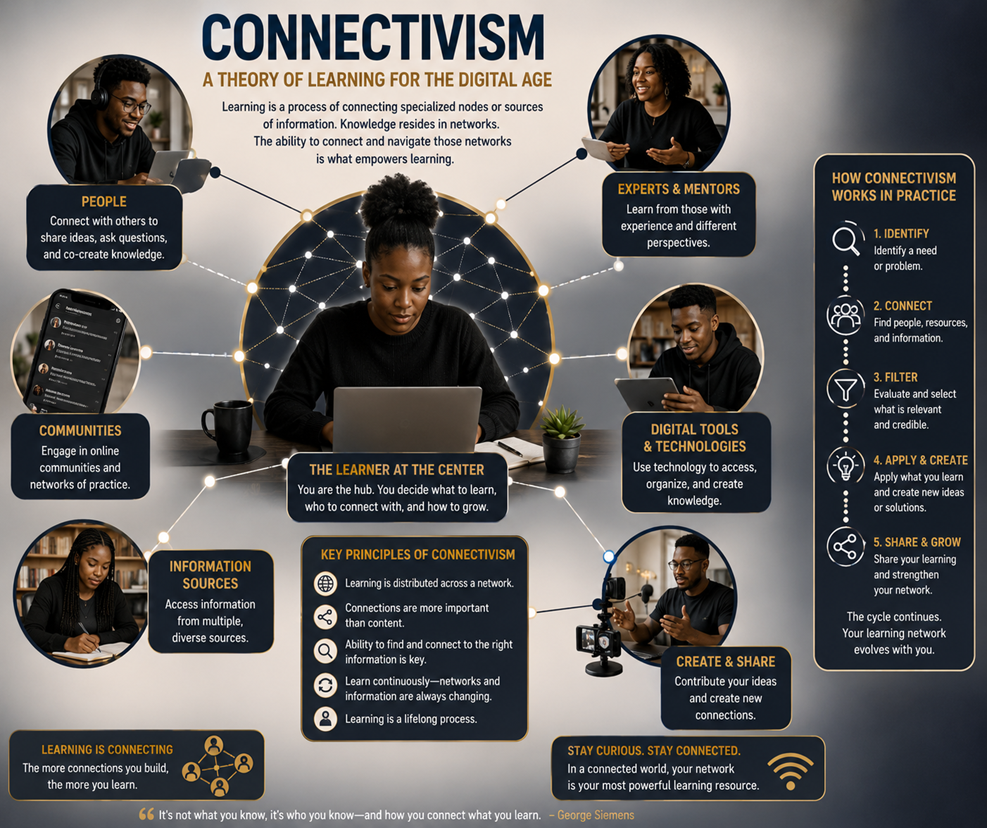
According to Siemens (2008), connectivism is a learning theory comprised of different series of nodes to connect hundreds of networks to facilitate synchronous and asynchronous learning (Dunaway, 2011). These connections provide individuals with direct access to reliable information from millions of sources to duplicate, reproduce, and share within their social networks, and to delete, critique, and discard inaccurate, irrelevant, and unreliable information
Connectivism is a learning theory designed to explain how individuals acquire knowledge in the digital age, emphasizing the role of technology in shaping learning processes. Unlike previous theories that focused on individual learning experiences, connectivism recognizes the interconnectedness facilitated by digital platforms such as the Internet, social networks, and various applications. It posits that knowledge is no longer confined to personal experiences or passive absorption but is actively constructed through collaboration and interaction with others.7
George Siemens (in 2004) and Stephen Downes (in 2005) said connectivism begins when an individual turns to digital technology to solve a problem. This can include actions such as googling a question, texting a friend, or searching for topical social media content.